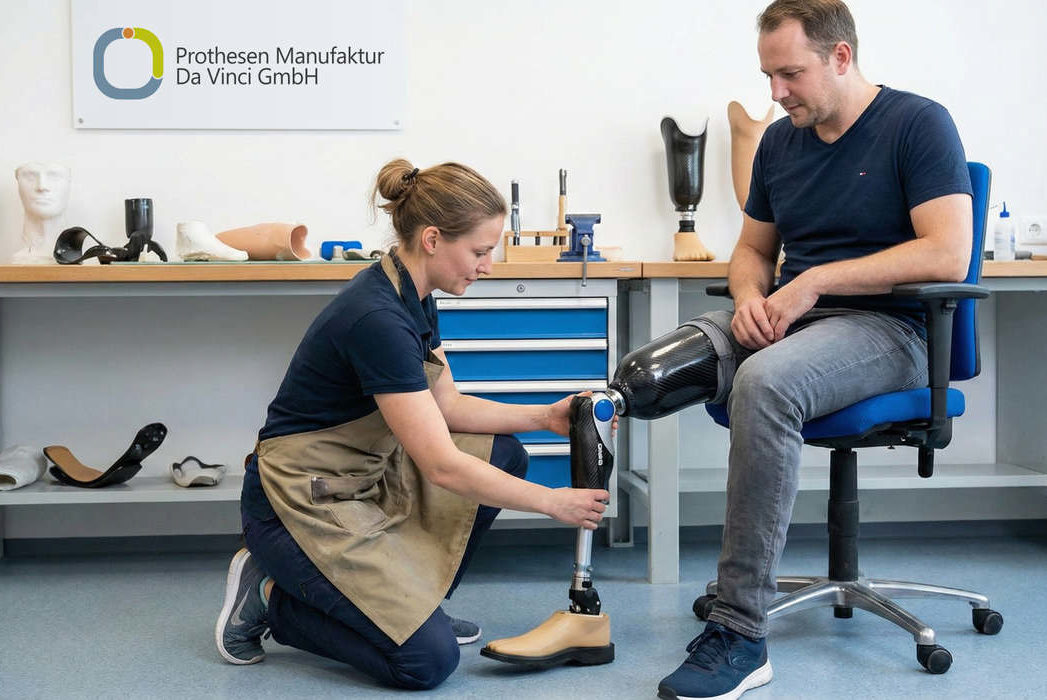
Information on Care and Everyday Life
Understandably, many uncertainties arise, especially in the initial period after an amputation. We want to help you gain clarity. Since every situation is individual, we are available for a personal consultation at our facility in Vienna at any time.
When is the right time for the first steps with the prosthesis?
As soon as the wound healing process is complete and there are no objections from a medical or orthopedic standpoint, the first attempts at standing and walking can begin. An early start is beneficial but must be approached carefully so as not to endanger the sensitive scar and muscle tissue of the residual limb.
What is an interim prosthesis?
After an amputation, the residual limb often still changes significantly. The interim prosthesis is a temporary fitting that allows us to react flexibly to changes in the residual limb. During this phase, you learn how to handle the assistive device. Additionally, this phase offers the opportunity to test various components for the subsequent permanent prosthesis.
How long does it take until I can walk securely with the prosthesis?
There is no blanket answer to this, as it depends on the amputation level and individual physical conditions. Comorbidities (accompanying illnesses) can also play a role. However, experience shows that many users achieve good mobility within a foreseeable period.
Is driving still possible?
Yes, there are numerous possibilities to technically adapt cars or motorcycles. Specialist companies can advise you on the necessary modifications. The responsible authorities and official inspection bodies provide information on the legal requirements and conditions.
Can I participate in sports again with a prosthesis?
The goal of prosthetic care is the extensive restoration of your mobility in everyday life and work. Depending on your general health and the achieved mobility grade (especially Grades 3 and 4), returning to work or engaging in sporting activities is often possible. In a personal consultation, we will clarify which special requirements your prosthesis must meet for this.
What about returning to work?
In many cases, resuming professional activity is possible. If your previous job involved heavy physical loads, reorientation or retraining may be useful. Institutions such as the Pension Insurance (Pensionsversicherung), Accident Insurance (Unfallversicherung), Health Insurance Funds (Krankenkassen), or the Public Employment Service (AMS) provide information on corresponding funding and measures.
How long does a prosthesis last?
The lifespan varies depending on usage, activity level, and the materials used. High stress in everyday life leads to faster wear. Physical changes (e.g., weight fluctuations or natural
atrophy
Wasting away or shrinkage of cells, tissues, or organs.
)may also necessitate adjustments. Additionally, the maintenance intervals specified by the manufacturers for the safety of the components must be observed.
At what intervals am I entitled to a new fitting?
If a prosthesis is defective or no longer functions safely, it is usually replaced or repaired by the funding body. Manufacturers also grant warranty periods on components. As soon as functionality or safety can no longer be guaranteed, we plan a new fitting with you.
Am I entitled to a disability pass?
Depending on the amputation level and the associated restriction, you are usually entitled to a disability pass. The final decision on the degree of disability is made by the responsible authority (in Austria, the Sozialministeriumservice).
What can I do about phantom pain?
Abnormal sensations or pain in the area of the missing limb are not uncommon. There are proven therapeutic approaches such as mirror therapy, medication, electrical stimulation, or modern methods using Virtual Reality (VR). Often, a combination of these measures leads to success. Our experience shows: With a well-fitting prosthesis, phantom pain occurs only rarely in most of our customers. It is important to distinguish between genuine phantom pain and pain caused by a prosthesis that does not fit optimally.
Can I wear shoes with high heels?
Standard prosthetic feet are often designed for a specific heel height. However, there are special components with adjustable heel height that allow for a flexible switch between flat shoes and heels.
How many hours a day can the prosthesis be worn?
If no pressure points or pain occur on the residual limb, the prosthesis can basically be worn the entire day. Should medical reasons speak against a long wearing duration, your treating physician will inform you. Ultimately, personal well-being decides how long the prosthesis can be worn.
Do You Have Questions?
We are happy to provide a personal consultation!
Do you have any unanswered questions, or would you like an assessment of your current fitting situation? No matter whether you are about to receive your first prosthesis or already have many years of experience as a user—we take the time to discuss your concerns in detail.
You are welcome to schedule an appointment for a personal consultation at our facility, or contact us in advance by phone. Together, we will clarify what concrete possibilities modern orthopedic technology offers for your individual needs.